
All Posts
2 min read
Spring Roundup 2026: Standards progress, new partnerships, and putting methodologies into action
Published on
June 3, 2026

.png)


It has been a busy few months on the conference circuit for the Seqana team, from the Carbon Farming Summit in Padua to the World Intelligent Farming Summit in Berlin last week. Between the events, the partnerships, and the standards activity, there is a lot to reflect on before summer gets into full swing.
Here is a roundup of some of what we have been working on:
.png)
Seqana co-authored VM0042 v3, released for public consultation earlier this year
Earlier this year, Verra opened the public consultation for VM0042 v3, co-authored by Seqana, TerraCarbon, and Verra . VM0042 is a leading methodology for soil organic carbon (SOC) projects on the voluntary carbon market, and version 3 and its accompanying Soil Sampling and Analysis Handbook (SSAH) represent a significant step in bringing more clarity to the methodology. The changes in Version 3 and guidance in the SSAH help maintain the scientific integrity of soil carbon sequestration claims without losing sight of the practical realities of implementing projects at scale.
One of the largest changes is the introduction of cumulative accounting to the methodology, which allows project developers to calculate sample sizes and uncertainty deductions against total sequestration since the project began, rather than just the change since the last verification event. In practice, this can dramatically reduce uncertainty deductions over a project's lifetime without compromising scientific integrity, and also creates the option to reduce sampling intensity as the project matures.
The update also clarifies how to implement emerging approaches like Digital Soil Mapping and Model-Assisted Estimations, and outlines Model True-up requirements, giving project developers clearer guidance on one of the more technically complex areas of SOC MRV. We've created a deep dive into some of the changes that will impact project developers the most which you can find below. The final version is expected in Q4 2026 (we'll keep you up to date on the latest).
Explore the VM0042 v3 changes in depth →
Discussing the SSAH on the ISCIA panel about the future of SOC measurement
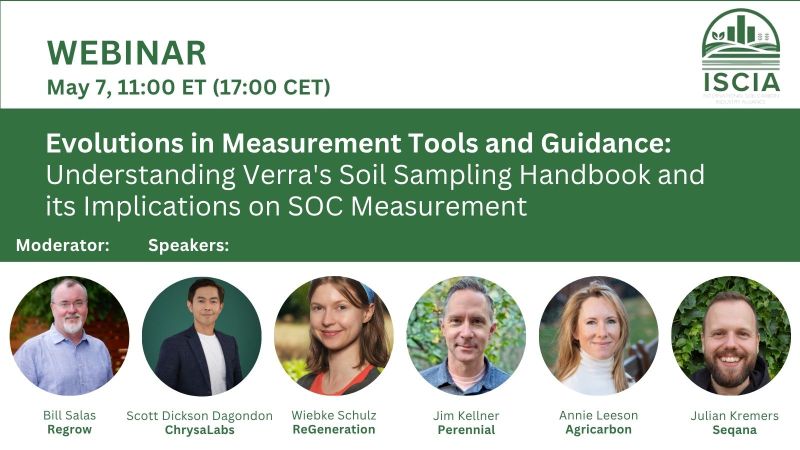
In May, Seqana's Co-Founder and CSO Julian Kremers joined a panel webinar hosted by the International Soil Carbon Industry Alliance (ISCIA) on the future of soil organic carbon measurement under Verra’s SSAH and how the practical implementation looks on the ground. The session brought together experts from across the field from co-authors of the methodology, to practitioners that must now implement these standards to provide their practical perspectives on a variety of topics. The panel discussed emerging sensing and sampling technologies, what updated standards like VM0042 mean in practice, and how to manage uncertainty in SOC quantification. Missed it? The recording is available to watch now.
.png)
Partnering with eAgronom on 300,000 hectares of SOC MRV across Europe
In February, we shared our longstanding partnership with eAgronom, a regenerative agriculture project developer based in Estonia that works with farmers and corporations to deliver high-quality carbon farming projects across Europe.
Together, we are working on MRV for projects spanning more than 300,000 hectares across six countries, including Spain, Romania, and Ukraine. Seqana provides expert MRV consultation on sample size calculations, SOC variance, and uncertainty deductions, and delivers sampling plans calibrated to the economically optimal sample size, balancing project economics, compliance, and long-term return on investment. eAgronom leads project development and works directly with farmers on the ground, supported by an in-house AI-powered remote sensing solution for land use history, field boundaries, and practice implementation.
.png)
Webinar Replay: What the GHG Protocol's LSRS actually requires from CPGs
We co-hosted a webinar with MyEasyFarm on the practical data and monitoring requirements of the GHG Protocol's Land Sector and Removals Standard (LSRS) and what they mean for agrifood companies working toward 2030 commitments.
The session covered why the pilot project phase is over, why primary data collection at the Land Management Unit (LMU) level becomes mandatory as soon as traceability allows. Julian highlighted and how the combination of digital MRV tools and Digital Soil Mapping can deliver both scientific rigor and economic viability at scale.
Nicolas Priou, EMEA Head of Regenerative Agriculture at Bunge, shared a firsthand perspective on field reality, data segregation challenges, and the deployment of the EIT Food project at scale.
.png)
Seqana partners with Chloris Geospatial for above-ground biomass carbon quantification
In May, we announced our partnership with Chloris Geospatial, combining deep expertise across both carbon pools for Afforestation, Reforestation and Revegetation (ARR) project developers operating under VM0047.
Our services complement each other and the requirements necessary to execute a successful VM0047 project. Seqana covers soil carbon: SOC potential analysis, project area stratification, and sampling design. Chloris brings the above-ground layer: stocking index, performance benchmarking, and dynamic baselines. VM0047 requires robust accounting of both pools, and this partnership means project developers no longer have to piece that together from separate providers.
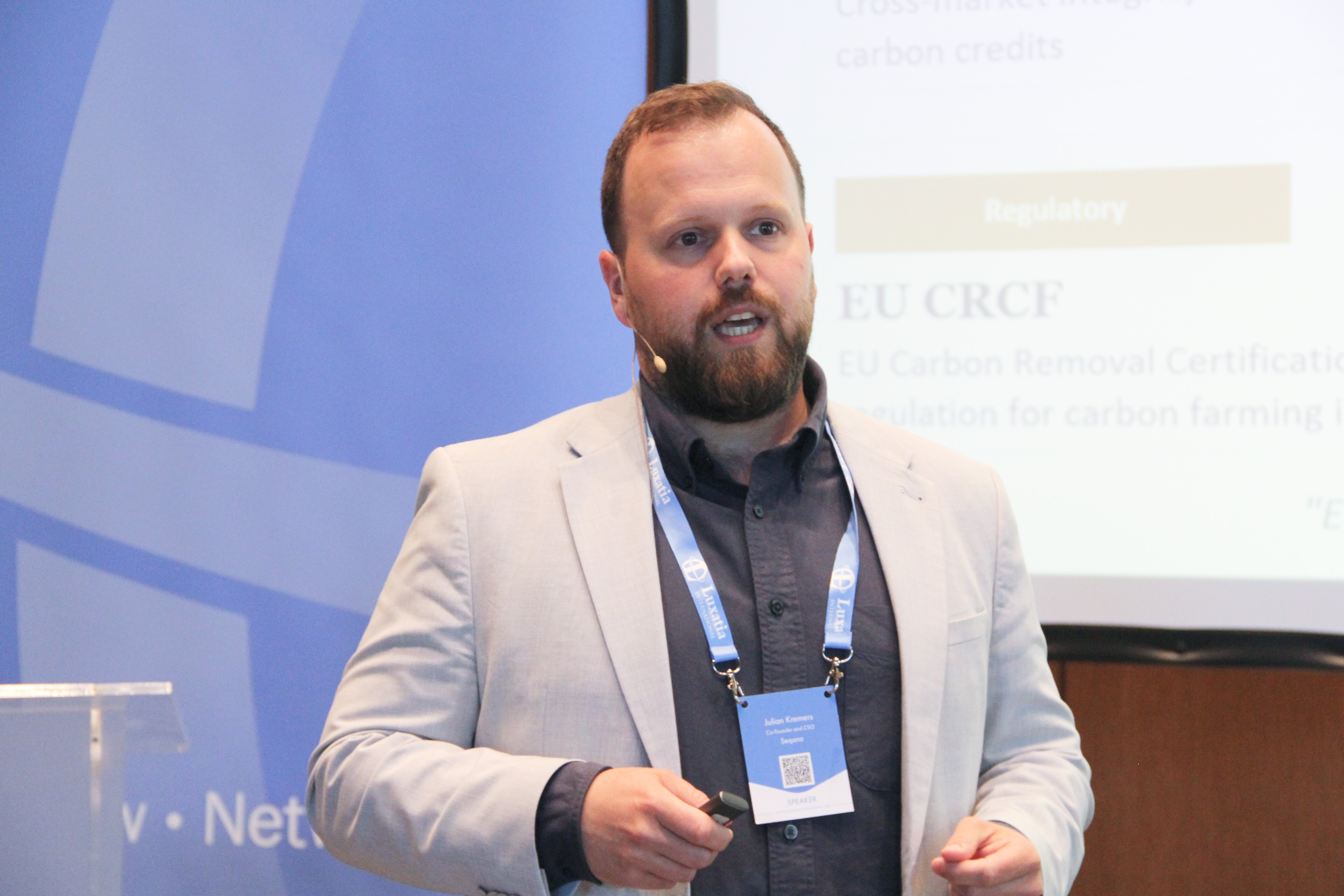
Julian Kremers: what a spring of conferences reveals about where the industry stands
It’s been a spring of conferences for the Seqana team starting with the Carbon Farming Summit in Padua and wrapping up at the the World Intelligent Farming Summit in Berlin last week. Here are some of the things I noticed as I reflect back on these experiences:
Methodologies, like Verra and LSRS, are starting to converge on agreed upon best practices for quantifying soil carbon and executing rigorous MRV at scale, think Digital Soil Maps built on a robust data set, which is exciting! With technological and methodological clarity progressing, we see companies with complex agricultural supply chains looking to build resilience against potential climate shocks, increasingly turning to soil carbon as the leading indicator for that work.
What's still needed? More companies with soil carbon as a measurement of soil health on their targets. More clarity among demand drivers for soil carbon as an indicator from legislation and policymakers ready to enforce it. The industry is moving steadily toward implementing regen ag at scale but that only means something if teams can quantify the success of their implementations with credible outcomes.
Follow our policy work with ISCIA →
Stay connected
It’s certain to be an exciting summer here at Seqana with more to share soon about some big milestones for Seqana and the industry. Make sure to follow us so that you can keep up to date with the latest!
Until next time,
The Seqana Team
Methodologies
Read more


© 2025 Seqana. All rights reserved.